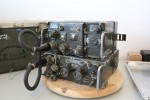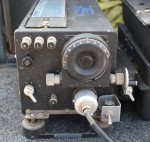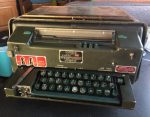
The AN/TRC-179 Force Terminal is part of the "Regency Net" system, which was a radio system fielded in the 1980s. Regency Net was designed to survive the electro-magnetic pulse (EMP) from a nuclear airburst. Thus, its members are a lot more complicated than other radio systems with similar capabilities, with lots of filtering on all electrical inputs and outputs. The set covers 2.0000 to 29.9999 MHz with LSB, USB and data modes. The Regency Net members include a frequency-hopping Electronic Counter-Countermeasures (ECCM) mode. The sets can function in single-channel mode with the ECCM card removed, and they were often deployed this way to non-military users such as FEMA.
Other members of the Regency Net system include the AN/GRC-215 manpack and the AN/GRC-215 Team Terminal, which consists of a GRC-215 manpack, crypto gear, a data terminal and other equipment which are all mounted in a frame and then installed in a CUCV truck.
Technical information for the Regency Net system is hard to come by, so this page will be very light on details. I believe that a complete AN/TRC-179 includes three of the transmitters shown here along with a lot of other equipment, and is housed in an S-280 communications shelter. I've seen references to the Regency Net system components being made by Magnavox and/or Elmer.
I don't have a list of all of the components of an AN/TRC-179 Force Terminal, but these are the components which are pictured here, and which I have determined are the minimum set of components to construct one complete high-powered SSB transceiver based on this system:
It took me several years to gather all of these components and the cables necessary to connect them together!
I've seen the AM-7296/U power amplifier referred to as a 400W amplifier. I measured the following power outputs when transmitting into a dummy load and blowing into the microphone:
| Mode | Measured PEP Output |
|---|---|
| Low Power | 16W |
| Medium Power | 60W |
| High Power | 300W |
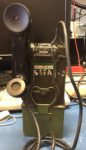
Although the system has the same kind of audio connectors as other Vietnam-era and later US equipment, it doesn't use all of the same audio accessories. It uses the H-356 handset, which looks just like the common H-250 handset but has a different connector pinout. In the H-356, the microphone ground connection is moved from pin A to pin E:
If an H-250 handset is used, receive audio and the push-to-talk (PTT) functions will work, but the transmitted audio level will be very low.
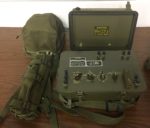
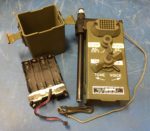
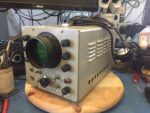
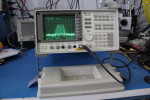
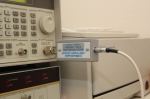
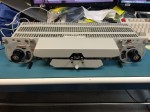
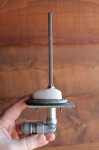
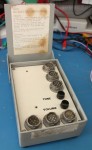
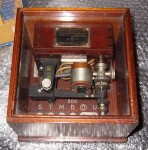
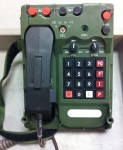
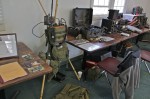
I have a number of test sets for the Regency Net system, which are pictured below. It's not a complete set, and what I have is a mixture of test sets for the AN/TRC-179 and the AN/GRC-215 systems.
Note the missing ECCM module (between the power regulator and CPU-I/O slots), and the reversible plate which indicates whether or not it is installed.
I have not yet obtained an power input cable or the proper power input plug for the PP-8097/G power supply, so I have temporarily spliced in power by dismounting and capping off the power input plug (a 4-pin plug from Souria's 840 series), mounting a cable clamp in the hole, and alligator-clipping a line cord onto the main breaker. This can be easily reversed if and when I get the correct plug, or I could make it semi-permanent by soldering the line cord onto the breaker's terminals.
A small fork-shaped piece on the back of the main breaker's lever was broken. I fabricated a replacement out of some tool steel stock in order to get the set up and running.
Here are test meter readings during my first smoke test. Everything looks good!