Crypto Room

Cryptographic (code and cipher) equipment and related stuff.

 
Loading Paper Tape into the Fialka Cipher Machine

A collector who just bought a Fialka cipher machine asked me how to load the paper tape, which is tricky until you’ve done it a few times. Here’s how I load the wide paper tape (for printing and/or punching) into my Czechoslovakian M-125-3 machine. His machine is a Polish M-125, but hopefully the paper path is about the same (I’ve never handled the earlier model of Fialka, so I’m not sure about that). The paper tape path is a bit different when using the narrower print-only paper tape, but I don’t have any to demonstrate with.

…  Read More!

 
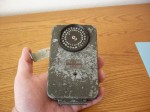
Hagelin CD-57 Pocket Cryptographer

The Hagelin CD-57 Pocket Cryptographer is a pocket-sized (for largish pockets) cipher machine which works on the same principal as the M-209 Converter. I’ll write a more detailed description later; for now, here are some pictures of my CD-57 that I found on eBay.

…  Read More!

 
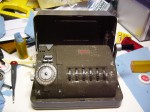
Hagelin CX-52 Cipher Machine

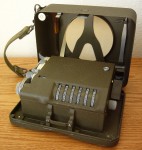
The Hagelin CX-52 cipher machine which works on the same principal as the M-209 Converter. I’ll write a more detailed description later; for now, here are some pictures of my CX-52 that I found on eBay, along with some details about how I cleaned up and repaired it.

…  Read More!

 
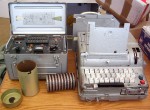
Soviet M-125-3xx "Fialka" Cipher Machine

The “Fialka” is a cipher machine which was made and used by the USSR during the Cold War. I found this one on eBay, and it only required minor repairs to become fully operational. I’ll write more detailed information about it later; in the mean time, here are some pictures of my Fialka. You can also find more details about this kind of machine on Wikipedia.

…  Read More!

 
KY-38 NESTOR Voice Encryption Device (Demilitarized)


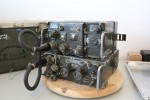
The KY-38 is the manpack variant of the NESTOR family of voice security devices. Used during the Vietnam War, this family included the KY-8 vehicular unit, the KY-28 aircraft unit, and the KY-38 manpack unit. These devices permitted secure voice communications over radio.

This particular unit has been demilitarized; that is, all of the cryptographic hardware has been removed from the unit before it was released as surplus, leaving only the case, power supply, interface circuitry, and an interesting electromechanical keying device. The battery box is also missing.

…  Read More!

 
Message Book M-210


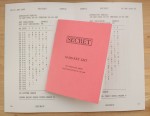
Message Book M-210 was, as far as I have been able to determine, the standard form for recording message traffic during World War 2. A great deal of rigorous procedure was necessary to reliably route message traffic, and part of that procedure involved composing messages on the standardized carbon-copy forms in Message Book 210 prior to submission to message centers for routing. The same forms were used by message centers when transcribing messages (for example, after encrypting them with Converter M-209), when receiving messages sent via radio, etc.

…  Read More!

 
M-209 Simulation Software

After I added an M-209-B Converter to my collection, I decided to write a software simulation of it as a learning exercise. Here is the result: a command-line application, written in C++, which is able to encipher and decipher text just like a real M-209 machine does. In addition, my simulator can generate new random keys and automate parts of the message-handling process. I’m releasing my simulator under the GNU Public License in the hope that it may be useful, educational and/or entertaining.

…  Read More!

 
Converter M-209-B

Converter M-209-B is a compact, portable mechanical cipher machine which was used by United States military forces during World War 2 and the Korean War. Designed by noted Swedish cryptographer Boris Hagelin, about 140,000 of the M-209 series machines were built. Unlike the German Enigma machine, this machine does not require an electrical power source. The U.S. Navy referred to this machine as the CSP-1500.

…  Read More!

 
2000 MRCG Meeting Highlights

Once again, the annual meeting of the Military Radio Collector’s Group was held at the Camp San Luis Obispo NCO’s club. The meeting was held on Friday, May 5 and Saturday, May 6, 2000. Friday was mostly dedicated to informal activities and display setup, along with some radio operating events and several really fun hidden transmitter hunts using 6m FM military radio gear. Cam Ogan, WA6VVC provided a fancy little hidden transmitter for us to find, and I bet it was funny to watch all of us guys running around with big, green radios and “rug-beater” direction-finding loop antennas! The swap meet, formal presentations, and David Ragsdale’s great barbecue were on Saturday. Unfortunately, I had to cut my visit short due to some engine trouble with my HMMWV, so I missed most of the fun on Saturday this year.

…  Read More!

© 2011 Mark J. Blair, NF6X Suffusion theme by Sayontan Sinha